
A late flight, a dawn departure or a workday that runs long can leave you asking the same thing: can you return rental cars after hours? In many cases, yes – but it depends on the rental company, the location and the exact handover process. After-hours returns can be very convenient, but they only stay convenient when you know what happens to the keys, when your hire officially ends and who is responsible for the car until staff check it in.
For a lot of Sydney renters, this matters more than the glossy brochure stuff. If you are heading to the airport before the counter opens, finishing a house move late, or trying to avoid paying for an extra rental day just because of business hours, after-hours drop-off can save time and money. The catch is that not every provider handles it the same way.
Can you return rental cars after hours at every company?
No. Some companies offer after-hours returns as a standard option, some only allow it at selected branches, and some do not allow it at all. Even when a company says it offers after-hours drop-off, there may be conditions attached.
A city branch, for example, may have a secure key box and marked parking bays, while a smaller location may require a staff member to meet you by arrangement. Airport-adjacent depots often have more flexible return systems because travellers are more likely to arrive outside regular hours. That is useful if you are flying out of Sydney early or arriving back late and want to avoid the big-brand airport pricing without giving up convenience.
This is why the safest approach is simple: do not assume. Check your booking terms before collection, not when you are already on the road.
How after-hours rental car returns usually work
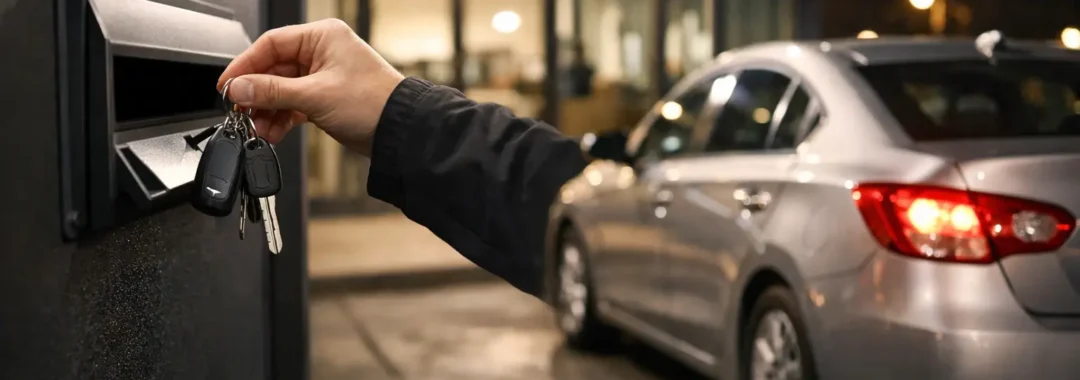
The basic process is usually straightforward. You park the vehicle in the designated return area, remove your belongings, lock the car, and place the keys in a secure drop box or follow the provider’s stated handover instructions. In some cases, you may also need to record the fuel level, odometer reading and bay number.
That sounds easy enough, but the detail matters. If you park in the wrong spot, return the car to an unsecured area or leave the keys somewhere other than the approved drop point, you may still be treated as having the vehicle in your possession. That can affect charges and liability.
A good provider will explain this clearly before your rental starts. If the instructions are vague, ask for them in writing. That way, there is no confusion later about where the car was left or when the return was made.
What happens to the keys?
Usually, the keys go into a locked drop box. Some branches may use a coded lock box or ask you to return them through a secure slot. A few operators offer a pre-arranged contactless handover.
What you should not do is improvise. Leaving keys in the glove box, under the mat or with nearby staff from another business is asking for trouble. If the company has not approved that method, it may not count as a proper return.
When is the car officially returned?
This is one of the biggest misunderstandings with after-hours drop-off. Many renters think the hire ends the moment they park the vehicle and walk away. Sometimes it does. Sometimes it does not.
At some companies, the return time is recognised when you place the keys in the secure drop box. At others, the vehicle is not formally checked in until staff inspect it when the branch reopens. If there is damage, a parking issue or a fuel shortfall discovered later, that can become a dispute if the process was not clearly documented.
What to check before you use after-hours drop-off
If you are comparing options, the right question is not just can you return rental cars after hours. It is what that return actually involves.
Start with the branch location. After-hours return can vary between airport, suburban and metro sites. Then check whether there is an added fee. Some budget-friendly operators include it as part of flexible service, while others charge extra for out-of-hours handling.
You should also ask about insurance responsibility. If you return the car at 11 pm and it is not inspected until 7 am, who covers the vehicle during those hours? The answer should be stated clearly in your rental agreement.
Fuel is another common issue. If your agreement says the car must be returned with the same fuel level, make sure you top up before arrival. You do not want to discover later that the nearest servo was closed and you have been charged a refuelling fee plus admin costs.
Finally, take your own record of the car at return time. A few photos on your mobile showing the exterior, fuel gauge, odometer and parking position can make all the difference if there is a later question.
Why after-hours return can save you money
For budget-conscious renters, this option is not just about convenience. It can reduce unnecessary rental costs.
Say your flight leaves early from Sydney Airport, but the branch opens after you need to be there. Without after-hours drop-off, you may have to keep the car for an extra half-day or full day just to hand back the keys in person. The same problem comes up with moving van and ute hire when jobs run past normal closing time.
A flexible after-hours return lets you pay for the time you actually need, not the time the office happens to be open. That is especially useful when you are already trying to keep travel or moving costs under control.
For that reason, some renters prefer smaller, service-focused providers over the major chains. A company like Low Cost Car Rental can often be more practical on this point because the service model is built around real customer schedules rather than rigid counter hours.
The trade-offs to know before you book
After-hours return is helpful, but it is not perfect for every situation.
If you like a staff member to inspect the vehicle with you, confirm fuel and close the booking on the spot, an in-hours return may give you more peace of mind. That face-to-face handover can be reassuring, especially for first-time renters, younger drivers, or anyone hiring a premium vehicle and wanting everything signed off there and then.
There is also the question of lighting and access. Returning a vehicle late at night in an unfamiliar area is less comfortable than dropping it off during the day. A well-located depot with clear signage, secure parking and simple key return instructions makes a big difference.
Then there is timing. If you are cutting it fine before a flight, allow extra minutes to find the correct entrance, park properly and complete any required steps. The process is easy when planned. It gets stressful when rushed.
Can you return rental cars after hours without extra risk?
Yes, if you treat it as a proper handover rather than just parking and leaving. A careful return lowers your risk considerably.
Make sure the car is clean enough that its condition is visible. Remove all personal items from the cabin, door pockets and boot. Check for obvious new marks. Take timestamped photos. Confirm the fuel level. Lock the vehicle. Put the keys only where instructed.
If the company asks you to notify them once the car is returned, do that straight away. A quick text, email or phone message noting the time and bay location creates an extra record. It is a simple step, but it helps.
When after-hours return makes the most sense
This option is especially useful for airport travel, weekend trips, moving jobs and business hires that do not fit neat office hours. It also suits families juggling school runs and flights, tradies finishing late with a van or ute, and visitors trying to keep their last day in Sydney simple.
The main thing is choosing a rental provider that explains the process clearly and does not hide the practical details in fine print. Cheap rates matter, but so does knowing exactly how the return works when the office is closed.
If you are booking a rental and your schedule is outside standard hours, ask the question early. After-hours return can be one of the handiest features in car hire – as long as the company offers it properly, spells out the terms and makes the drop-off easy to follow.
That little bit of checking upfront can save you a lot of mucking around later.
